|
|
ROD GYMNOCALYCIUM
PODROD V. -
MUSCOSEMINEUM Schütz
Gymnocalycium friedrichii (Werd.) Pažout
Fričiana IV, 3 – 19, 1964
Basionym: Gymnocalycium mihanovichii var. friedrichii Werdermann
Kat. Tab. 113, 1936
Od typu (rozumějme Gymn. mihanovichii) se liší vyššími a tenšími žebry, která jsou kolem areol silně zesílená, areoly poněkud vystouplé, trny většinou olámáné, někdy i úplně chybí, květy sytě růžové. Okvětní lístky při plném otevření zcela zahnuty ven a zpět dolů k tělu rostliny.
Domovina: Chaco Boreal. Bolívie, Charaqua, sev. Cumbary.
Taxon je pojmenován na počest svého nálezce Adolfo Maria Friedrichovi. A.M. Friedrich byl původem Němec usazený v paraguayském Asuncionu. V letech 1933 až 1935 probíhala válka mezi Paraguayí a Bolívií o nerostné bohatství v Chacu, hlavně o naftu, válka pak skončila porážkou Bolívie a připojením velkého území, do té doby bolívijského Chaca. A.M. Friedrich tehdy jako mladý muž pracoval jako válečný dopisovatel a tak se dostal po nově vystavěných komunikacích do do té doby nepřístupného Chaca. Při cestách sbíral i kaktusy, které měl vysazené na své zahradě v Asuncionu, mezi nimi i Gymn. friedrichii, ale úplně přesné místo sběru si později nepamatoval. Po konci války navštívili Friedricha v Asuncionu Harry Blossfeld a Oreste Marsoner, všechny kaktusy a semena koupili a poté je nabízeli ve svých cenících. Ing. Ryšánek z Brna byl úspěšný ve výsevech, po úrazu ale všechny rostliny předal Zdeňku Fleischerovi.
Pražský kaktusář ing. František Pažout si velmi oblíbil příbuzenský okruh Gymn. mihanovichii – friedrichii, pěstoval a pozoroval je řadu let a poté popsal několik variet, z nichž ale některé byly zahradnické výpěstky nebo vybrané jednotlivé odchylky a tak nebyly uznány. Takovými taxony byly var. angustostriatum (nebo stenostriatum), var. melocactiforme, var. ryšánekianum a var. fleischerianum. Také takovým taxonem je pravděpodobně Gymn. mihanovichii var. pirarettaense, později překombinovaná na Gymn. friedrichii var. pažoutianum, v přírodě nenalezeno, asi kříženec s Gymn. anisitsii.
Další nálezy: STO 977, STO 976, STO 971; Lau 373 Laguna N. Charaqua Bolívie; LB 2178 v. Aqua Dulce; VoS 03-62A sev. Cumbary Bol.
Další nálezy jako Gymn. friedrichii var.: LB 2211 Nueva Asuncion, LB 2218 Cerro Leon; HU 311 Paraguay, HU 312 Paraguay, HU 313 Paraguay, HU 314 Paraguay.
Na druhé straně jsou pěkné taxony Gymn. friedrichii var. moserianum (synonym Gymn. stenopleurum Ritter), a Gymn. friedrichii var. albiflorum.
Doplněk ing Pavel Tůma: Gymn spec 17A - slavný liberecký kultivar, pojmenovaný po Františkovi Venclů, zářezy na žebrech svědčí o hybridním původu podobně jako u pirarety, přesto je to zajímavá kytka a v několika generacích výsevů překvapivě geneticky ustálená.
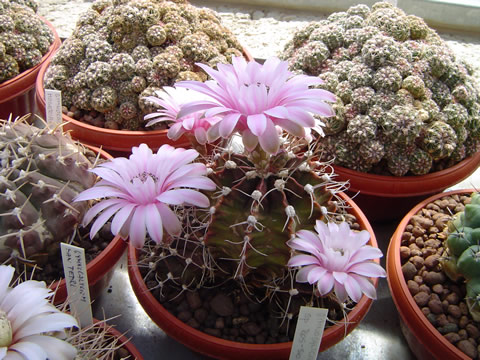
Gymnocalycium friedrichii
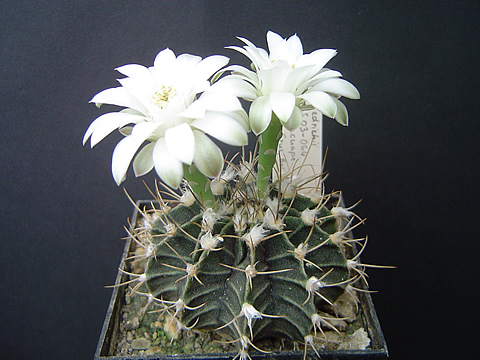
Gymnocalycium friedrichii VoS 03-064 Ipitacuape, Santa Cruz, Bolívie, mnohožeberné rostliny
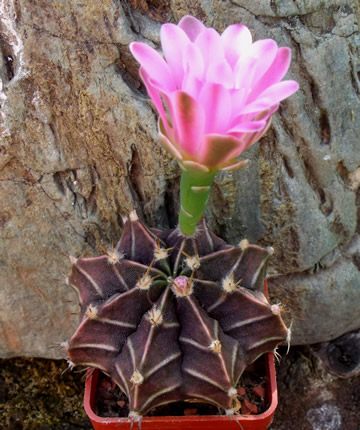
Gymn friedrichii typ prof Werdermann, foto ing Pavel Tůma
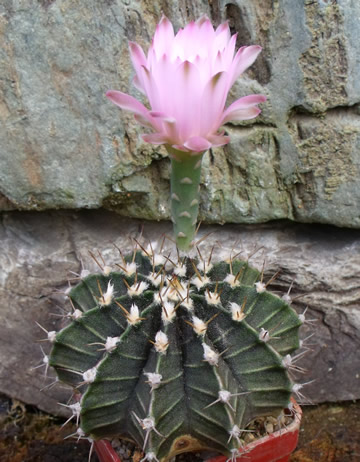
Gymn friedrichii HU 313, foto ing Pavel Tůma
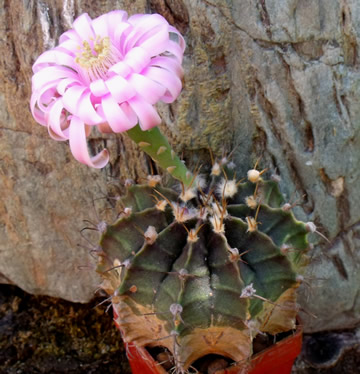
Gymn friedrichii HU 313, foto ing Pavel Tůma
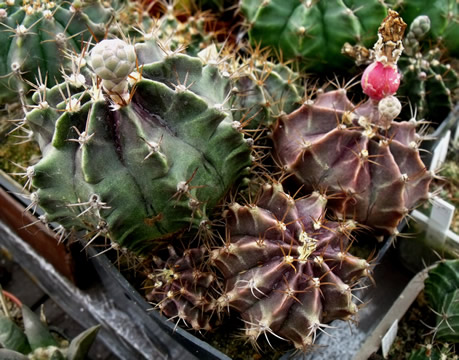
Gymn sp 17A, foto ing. Pavel Tůma
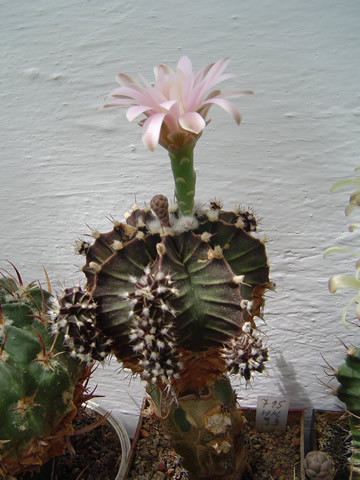
Gymn. friedrichii v. angustostriatum
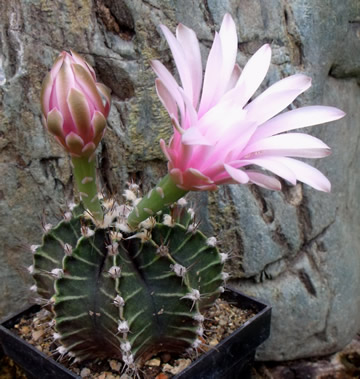
Gymn. friedrichii v. angustostriatum, foto ing Pavel Tůma
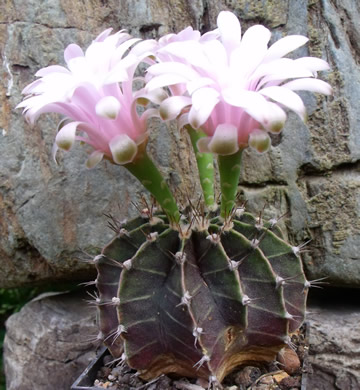
Gymn. friedrichii v. angustostriatum, foto ing Pavel Tůma
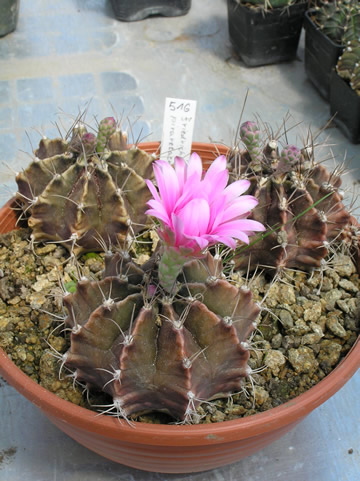
Gymn. mihanovichii v. pirarettaense - foto Marek Grepl
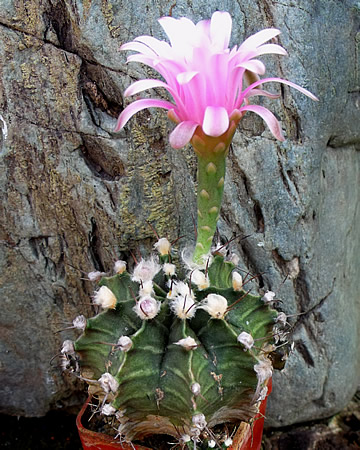
Gymn. friedrichii fleischerianum, foto ing Pavel Tůma
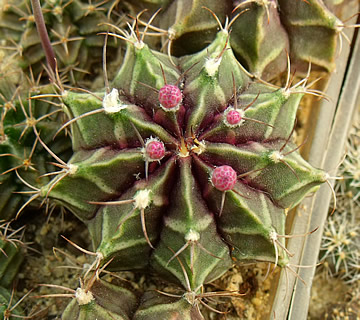
Gymn. friedrichii melocactiforme, foto ing Pavel Tůma Gymn. friedrichii var. moserianum Pažout
Fričiana VI, 37, 19, 1966
Liší se od typu Gymn. friedrichii dvojnásobnou velikostí těla, jen třemi trny v areole a bílým květem.
Domovina: podle nových výzkumů Parapeti.
Další výskyt hlášen od obcí Teniente Enciso, Americo Picco, Cruce 4 de Mayo.
Někteří badatelé tvrdí, že synonymem tohoto taxonu je Gymn. stenopleurum, ale zatím zde tuto otázku necháváme otevřenou.
Další nálezy: WO 79 Teniente Enciso; P 435 Americi Picco; LB 2193 již. Cruce 4 de Mayo, LB 2203 10 km již. Teniente Enciso, LB 2206 Teniente Enciso, LB 79 Mariscal Estigarribia Americo Picco; HU 309 Paraguay; GM 789.
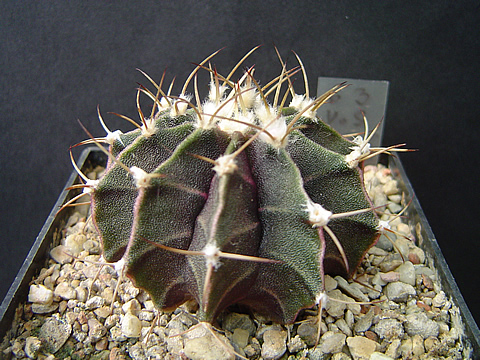
Gymnocalycium friedrichii var moserianum VoS 335 Gymn. friedrichii var. angustostriatum Pažout ex Milt
Cactaceae etc. (Slovensko), 2016/2, str. 61-63
Stonek jednotlivý, 7-10 cm v průměru, 4-8 cm vysoký, zploštěle kulovitý, s prohloubeným vrcholem, epidermis tmavě zelená až šedozelená, na slunci s červenohnědým nádechem, hustě jemně zrnitá. Kořeny vlásčité. Žebra 8-12 v počtu, přímo svisle probíhající, velmi ostrá, u temene v řezu 0,5 cm široká při základně a 1,5 cm vysoká, u základny stonku až 2 cm široká. Žebra mezi areolami mírně zvlněná. Areoly jen lehce vnořené. Tenké a z epidermis výrazně vystouplé linky směřují od areol k zářezům mezi žebry, tyto linky jsou obloukovitě vyhnuté směrem nahoru. Linky stínované shora šedobíle, zespodu široce fialově hnědě. Areoly kulaté, 2-4 mm široké, zpočátku silně bíle vlnaté, vlna v kultuře dlouho přetrvává. Trn pouze jeden již od mládí, směřující dolů, někdy mírně zakřivený doleva nebo doprava, zahnutý zpět směrem k žebru, 3-4,5 mm dlouhý, slámově žlutý s hnědou špičkou, později šedý.
Květ až 45 mm dlouhý, 40 mm široký, bílý. Trubka 25-30 mm dlouhá, světle zelená až zelená, s bíle lemovanými šupinami. Šupiny v horní části trubky a vnější okvětní lístky s narůžovělými špičkami. Okvětní lístky bílé, vnitřní okvětní lístky se plně otvírají jen za vyšších teplot po poledni. Prašníky šedé, blizna krémově bílá. Plod červený, vřetenovitý. Semena podrod Muscosemineum Schütz.
Domovina: Paraguay, Alto Paraguay, Aqua Dulce. Již bylo objeveno další místo výskytu, zatím je však v přísném utajení – jedinci s růžovými květy.
Neotyp uložen v herbáři OLM (Vlastivědné muzeum v Olomouci) pod číslem B 171.482.
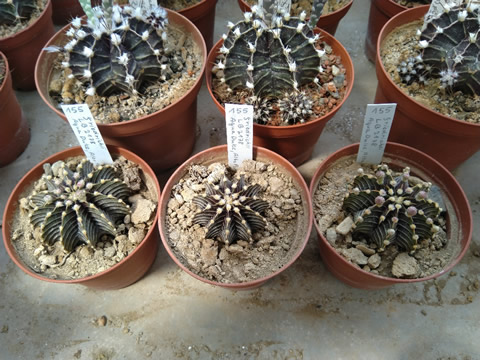
Gymnocalycium friedrichii angustostriatum LB 2178 Aqua Dulce Původní popis Pažouta 1962: Malé tělo o průměru jen 3-4 cm má zrnitou, vždy tmavě fialově zelenou pokožku. Asi 12 velmi úzkých ostrohranných žeber s nápadně hustě příčně pruhovanými a přitom jen mělce rýhovanými žebry (světlé proužky jsou jen 2-3 mm vzájemně vzdálené) nese malé sblížené areoly, vytvářející jen v mládí hustou bílou dlouze vláknitou vlnu, a po jednom křehkém žlutém ostnu. Ostny i vlna však záhy mizí, takže rostlina je zcela lysá. Květy vyrůstají z temene a mají světle růžové, velmi četné okvětní lístky a šedozelené prašníky.
Pažoutovy poznámky 1962: Z prvních Blossfeldových zásilek původních semen, nasbíraných v Chacu Boreal okolo roku 1935 A.M.Friedrichem vyklíčilo u nás mnoho zajímavých nových gymnokalycií. Ve sbírkách se z nich ve větším množství uchovaly jen rostliny pojmenované v roce 1936 Werdermannem Gymnocalycium mihanovichii var. friedrichii. Z téhož semene však vzácně vyrůstala i jiná gymnokalycia, náležející většinou do téhož příbuzenského okruhu. Některá z nich charakterizoval již Werdermann. V letech 1948 a 1951 jsem z nich popsal jako variety G. mihanovichii: var. piraretaense, var. fleischerianum a var. melocactiforme, jiná (možná zčásti i stejná) označil později Buining (např jeho F-17 se téměř shoduje s var. piraretaense), resp. Popsal Y. Ito. Další odlišné odrůdy zkoumám ve své sbírce již přes 20 let. Některé z nich si pro charakteristickou odlišnost zaslouží, aby byly uchovány i samostatným pojmenováním. Jsou mezi nimi např. hustě otrněné, vždy svěže zeleně pruhované mihanoviče s porcelánově bílým květem, miniaturní rostlinky s dlouhým prohnutým středním ostnem a útlými bílými kvítky atd. Návštěvníci mezi nimi vždy nejvíc obdivovali nápadně tmavofialové, hustě proužkované exempláře s četnými bezostnými, úzkými a ostrými žebry. Tato nápadná krásná varieta, stojící nejblíže Werdermannově var. friedrichii, od níž se však svými četnými úzkými, hustě proužkovanými žebry na první pohled liší, pochází z výsevu F. Švece, který měl v roce 1937 ještě původní semeno z Blossfeldovy expedice. Roste velmi pomalu, takže 20 let staré roubované exempláře jsou jen 4 cm široké a 8 cm vysoké. Podložkové echinopsis pod ní rychle dřevnatí jako pod ariokarpusy.
Kleine Körper mit Durchmesser von nur 3-4 cm, körnig, immer dunkel violettgrüne Epidermis. Etwa 12 sehr enge Rippen mit scharfen Kanten, auffallend dicht quer gestreift und dabei nur seichte gerillte Rippen (seichte Streifen sind nur 2-3 mm von einander entfernt), diese tragen kleine sich nahe Areolen, nur in der Jugendzeit dichte weisse Wolle mit lange Fasern und einen spröden gelben Dorn. Dornen und Wolle jedoch bald schwinden, so das die Pflanze ganz kahl ist. Blüten wachsen aus dem Scheitel und haben leicht rosa, sehr zahlreiche Blütenblätter und graugrüne Staubbeutel.
Gymnocalycium mihanovichii var. angusto-striatum PAŽOUT var. nov.
Descriptio:
Costis numerosis (usque ad 12), angustioribus, densissime ac anguste striatis striis tantum 2-3 mm latis, areolis cpndensatis, jam in státu juvenili decalvescentibus, tomentum album et aculeum luteum unicum amittentibus a forma typica et a varietate friedrichii differt. Flores, fructus, seminaque ut in varietate friedrichii.
Viele interessante neue Gymnocalycien keimten hier aus ersten Blossfeld Sendungen. Die Originalsamen wurden von A.M.Friedrich gesammelt im Chaco Boreal rund um das Jahr 1935 gesammelt. Nur die Pflanzen G. mihanovichii var. friedrichii von Werdermann im Jahr 1936 beschrieben blieben in den Sammlungen in grössere Mengen vorhanden. Auch die anderen seltenen Gymnocalycien wuchsen aus den gleichen Samensendungen, diese gehören größtenteils in das gleiche verwandtschaftlichen Umfeld. Werdermann charakterisierte schon einige von ihnen. Ich beschrieb von ihnen die Varietäten Gymnocalycium mihanovichii: var. piraretaense, var. fleischerianum und var. melocactiforme im Jahre 1948 und 1951. Die anderen Pflanzen (möglich teilweise auch die gleichen) beschrieb später Buining (zum Beispiel sein F-17 ist beinahe übereinstimmed mit var. piraretaense), respektive Y.Ito. Ich forschte an anderen verschiedenen Arten in meiner Sammlung schon seid über 20 Jahren. Einige von ihnen sollte man wegen der charakteristischen Unterschiede mit einer selbständigen Benennung bewahren. Sie sind auch dicht bedornt, immer mit frisch grünen streifen, mihanovichii mit Porzellan weissen Blüten, zwergenhafte Pflanzen mit langem gebogenen Mitteldorn und zarten weissen kleinen Blüten. Besucher bewunderten immer die zumeist auffallend dunkelviolett, dicht gestreiften Exemplare mit zahlreichen schmalen, scharfen Rippen ohne Dornen.
Diese auffallende schöne Varietät gehört in die nächste Verwandschaft zu Werdermann´s var. friedrichii, sie unterscheidet sich von diesen auf den ersten Blick mit sein zahlreichen dichten gestreiften Rippen.
Diese stammen aus der Aussaat von Herrn F. Švec, er hatte noch Originalsamen aus dem Jahr 1937 von der Expedition von Blossfeld. Die Pflanzen wachsen sehr langsam, eine 20 Jahre altes gepropftes Exemplar ist nur 4 cm breit und 8 cm hoch. Die Echinopsis darunter ist schnell verholzt so wie unter Ariokarpen.
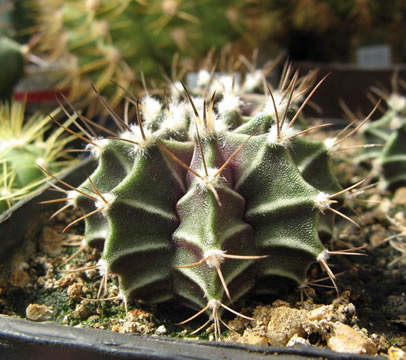
Gymnocalycium friedrichii v moserianum, foto Albert Skrovan
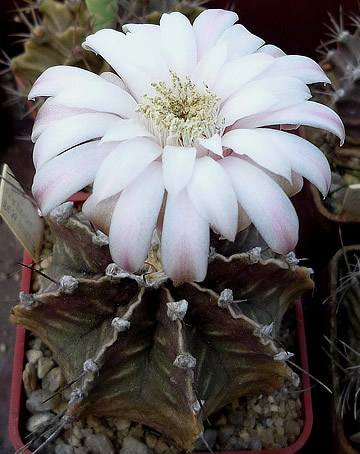
Gymn. friedrichii moserianum WO 79, foto ing. Pavel Tůma
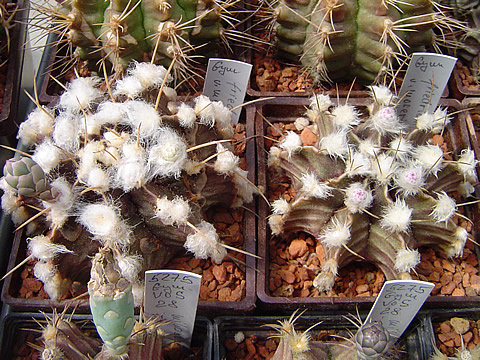
Gymnocalycium friedrichii v moserianum Gymn. friedrichii var. angustostriatum VoS 14a
Gymn. friedrichii var. angustostriatum VoS 14a, forma nalezená německým gymnofilem Volkerem Schädlichem, východně od Aqua Dulce v Paraguayi v departmentu Alto Paraguay. Jde o velmi krásnou formu kvetoucí bílým květem, plody jsou červené. Rostliny jsou charakteristické ostrými souvislými žebry, která mají příčné světle zbarvené pásky ve tvaru oblouku vypouklém nahoru. Areoly mohou být zcela bez trnů, nejčastěji však nesou jeden dolů směřující trn. Ve sbírkách se také mohou vyskytovat pod číslem LB 2178.
Fantastická novinka, která svým vhledem v ničem nezadá s takovými šperky, jako je Aztekium hintonii! Škoda jen, že se takového podrobného průzkumu nalezišť podrodu Muscosemineum nedožil ing. František Pažout.
A zpráva nálezce Volkera Schädlicha: Dále jsem v tomto místě našel Gymn. eurypleurum. Znovu jsem navštívil naleziště roku 2006 a roku 2009, ale více jsem je nenašel. I tak zůstává nejsevernějším nálezem jakékoliv formy Gymn. friedrichii. V tomto okolí jinak najdete pouze Gymn. mihanovichii. Roku 2009 jsem intenzivně prozkoumal okolí Bahia Negra ještě jednou, ale bez výsledku. Jde o zcela izolované naleziště formy Gymn. friedrichii. Rostliny které jsou označovány podle starého popisu Gym.n friedrichii v moserianum, rostou vzdálené vzdušnou čarou 235 km dále na jihovýchod. VoS 14a zůstává i v kultuře poměrně malé…………. A i větší rostliny mají pouze jeden trn, semenáčky mají také pouze jeden trn. Je třeba poděkovat za iniciování tohoto bádání Marku Greplovi, gymnofilovi z Třebčína, a Volkeru Schädlichovi za informace o nalezišti.
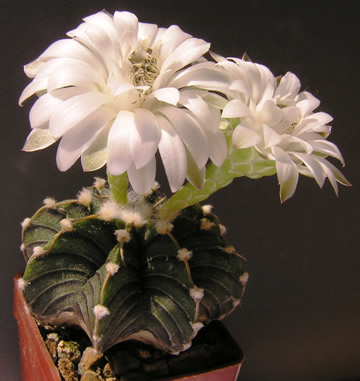
Gymnocalycium VoS 14a, foto Marek Grepl
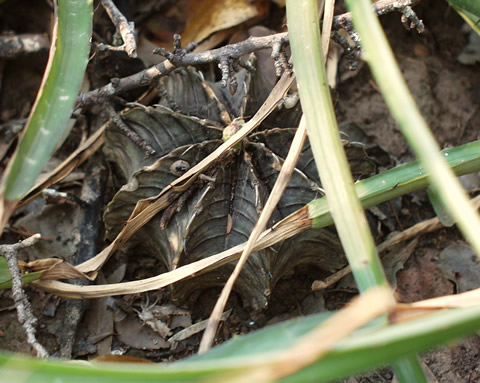
Gymnocalycium VoS 14a, foto Volker Schädlich
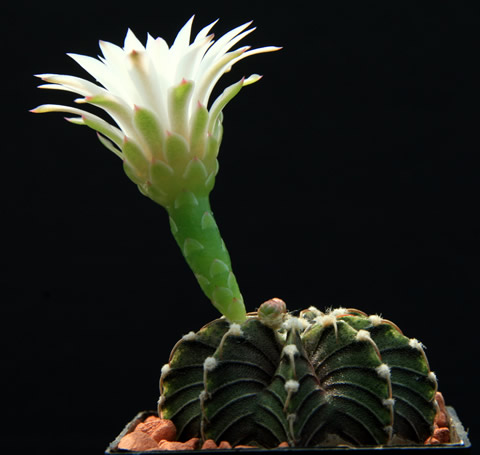
Gymnocalycium VoS 14a, foto Volker Schädlich
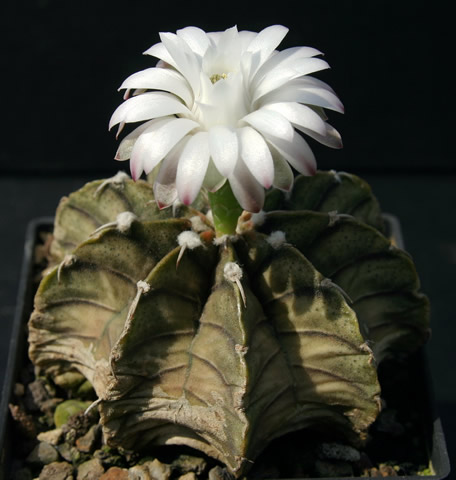
Gymnocalycium VoS 14a, foto Volker Schädlich
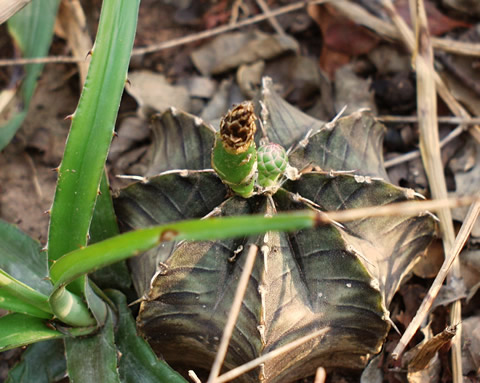
Gymnocalycium VoS 14a, foto Volker Schädlich
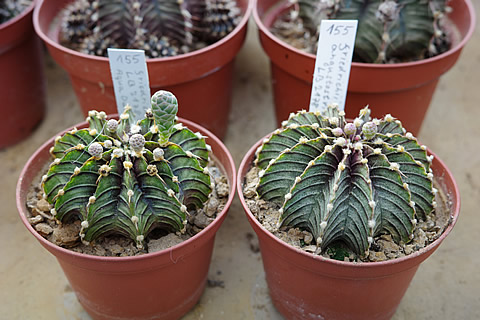
Gymnocalycium friedrichii angustostriatum LB 2178 foto MG
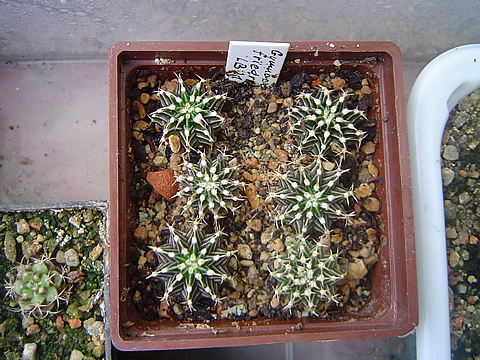
Gymnocalycium friedrichii angustostriatum LB 2178 dvouletá drobotina
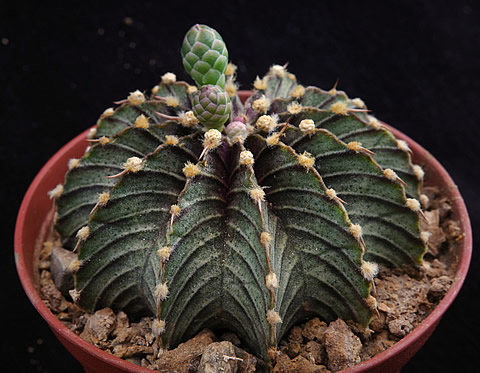
Gymnocalycium friedrichii angustostriatum LB 2178
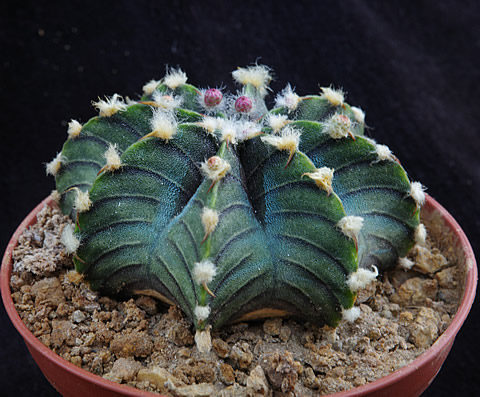
Gymnocalycium friedrichii angustostriatum VoS 14a foto MG
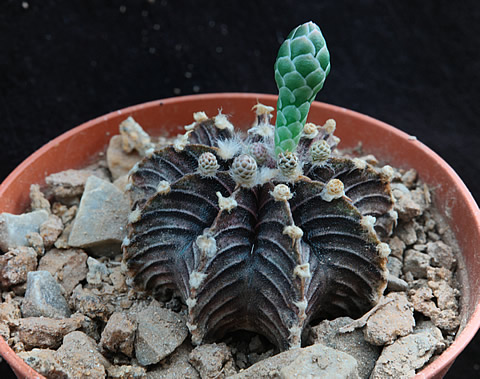
Gymnocalycium friedrichii angustostriatum VoS 1241 foto MG
Gymn. friedrichii var. angustostriatum VoS 14a, die Form von dem Deutschen Gymnofil Volker Schädlich gefunden,östlich von Aqua Dulce, Alto Paraguay, in Paraguay. Es gibt sehr schöne Form mit den scharfen kompakten Rippen die die quer hell gefarbene Gürteln in die Form von einem Bogen hinauf bauchig haben, die Areolen sind fast ohne Stacheln. Eine fantastische Neuheit! Schade, daB ing František Pažout diese eingehende Aufklärung von den Fundorte von Gymnokalycien von der Untergattung Muscosemineum nicht erlebte. Man kann diese Pflanzen in den Sammlungen unter die Nummer LB 2178 sehen.
Und Volker Schädlich: Ich fand diese Pflanzen vor 10 Jahren auf meiner ersten Reise nach Paraguay. Weiterhin fand ich an diesem Fundort G eurypleurum. Ich war 2006 und 2009 erneut in dieser Gegen und konnte diese Pflanzen nicht mehr finden. Es bleibt somit der nordöstliche Fund einer friedrichii Form überhaupt. In dieser Gegend gibt es sonst nur Gymn mihanovichii. Im Jahr 2009 habe ich die Gegend von Bahia Negra kommend noch einmal intensiv abgesucht, ohne Erfolg. An Gymnos nur mihanovichii. Es ist bisher ein absolut isolierter Standort einer friedrichii Form. Die Pflanzen, die man laut alter Beschreibungen friedrichii v moserianum bezeichnet, wachsen Luftlinie ca 235 km weiter südöstlich davon. Auch die groBen Pflanzen bei mir in Kultur haben nur einen Dorn. Ein Merkmal das konstant bleibt. Bei meinen bisherigen Aussaaten hatten alle Sämlinge auch nur einen Dorn.
VoS 14a in English: Gymn. friedrichii var. angustostriatum VoS 14a. The form found by the German Gymnofil Volker Schädlich east of Aqua Dulce in Paraguay in the department of Alto Paraguay. I tis very beautiful form with white flower, fruits are red. The plants are characteristic with sharp continuous ribs which have transversál light coloured strips in the shape of the bow upwards bulging. Areoles can be quite without spines, however, mostly Theky have one spine downwards directing. It can be seen in collections also with the number LB 2178.
Fantastic novelty like the gem Aztekium hintonii. It is a pity that ing František Pažout had not lived to see this detailed searching of the finding places of the subgenus Muscosemineum.
The words of the discoverer Volker Schädlich: Gymn eurypleurum had been found also in this area. I visited the finding place in 2006 and 2009 but I have not found them more. Nevertheless it is the northest find of any form of Gymn friedrichii. On the other hand one can se ethere only Gymn mihanovichii more. I searched intensiv the environs of Bahia Negra once more in 2009 but without success. It is quite isolated finding place of the form of Gymn friedrichii. The plants which are marked after the old description of Gymn friedrichii var moserianum grow 235 km far to the southeast as the crow flies. VoS 14a is still small also in the culture. Even bigger plants have only one spine, seedlings have also only one spine.
Gymnocalycium friedrichii subspec. tumaemulticostatum Ivan Milt
Cactaceae etc. (Slovensko) 1/2018, str.7 – 9.
Stonek jednotlivý, 7 – 10 cm v průměru, 4 – 6 cm vysoký, ve stáří sloupovitý a až 10 cm vysoký, ploše kulovitý s prohloubeným temenem, temeno hned zpočátku vytrněné, stonky zřídka odnožující. Epidermis tmavě zelená, zrnitá, se silným černofialovým tónem, na přímém slunci stonky červenají. Kořeny vlásčité. Žebra 14 – 18 v počtu, přímo svisle probíhající, u temene 3 – 4 mm vysoká, u základny stonku až 2 (-2,5) cm široká, 1,5 – 2,5 cm vysoká, velmi ostrá, mezi areolami mírně zvlněná. Výrazné proužky na bocích žeber vedoucí od areol ke svislým zářezům mezi žebry jsou prohnuté mírně nahoru, horní okraj proužku bělavě zelený, spodní okraj proužku černofialový až černohnědý. Svislé zářezy mezi žebry mírně zvlněné.
Areoly kulaté až mírně oválné, 1,5 – 2 mm v průměru, s bílou vlnitou plstí, která zády šedne. Okrajové trny 3 – 5 (-7), jehlovité, silně odstávající, nepravidelně paprskovitě rozprostřené, většinou mírně nahoru směřující, jeden spodní okrajový trn dolů mírně směřující, 0,7 – 1,5 cm dlouhé. Střední trn 1, nahoru směřující a zahnutý až 2,5 cm dlouhý. Všechny trny rohově šedé s hnědými špičkami.
Květ 5,5 cm vysoký, při anthesi asi 4,2 cm široký, bílý. Trubka asi 2,4 – 2,8 cm dlouhá, u zákkladny 2,5 mm silná, u vrcholu 5 mm silná, zevně (smaragdově-) zelená, lesklá, s cca 8 – 9 šupinami o šířce 3,5 mm a výšce 2 – 3 mm, šupiny sy sytěji zelenou základnou, bělavými okraji a nahnědlou skvrnou tvaru půlměsíčku. Ovarium bílé, 2,1 – 2,3 cm vysoké, 2 – 3,5 mm široké. Stěny ovaria v řezu světle zelené. Receptakulum bílé, zpočátku 2 mm široké, potom oválné až skoro kulaté, cca 1 cm vysoké. Vnější okvětní listky: šupiny nad trubkou plynule přecházejí do okvětních lístků, které jsou nejprve zevně světle zelené s bílými okraji a hnědavou špičkou pod vrcholem ve tvaru nehtu. Lístky 1 – 2 cm dlouhé, 4 – 5 mm široké, kopinaté. Vnitřní okvětní lístky bílé, kopinaté, 1 – 2 cm dlouhé, 4 – 5 mm široké. Čnělka 7 – 8 mm vysoká, 1,5 mm silná, bílá. Blizna bílá, 5 – 7 mm vysoká. Primární prašníky při základně receptakula krátké, přiklánějí se ke třetí třetině čnělky. Sekundární prašníky vyrůstají až na úrovni blizny, jsou světle nazelenale hnědé a přesahují bliznu. Nitky bílé, až 0,8 cm dlouhé.
Plod zelený, ve zralosti červený, 5 – 7,5 cm vysoký, 0,8 – 1,2 (-1,8)cm široký, se zaschlými zbytky okvětí, úzce vřetenovitý až vřetenovitý. Semena podrodu Muscosemineum.
Domovina: Bolívie, Santa Cruz, Ipitacuape. Taxon patří do okruhu Gymnocalycium friedrichii, od kterého se liší tvorbou mnoha žeber a delšími květy, mnohem delším a tenším všetenovitým plodem a také zcela odloučeným přírodním stanovištěm.
Holotyp: Materiál holotypu uložen v Herbariu Krajského Vlastivědného muzea v Olomouci pod číslem B 171.826. Typová kultura ve sbírce Ivan Milt, původní sběr VoS 03 – 064 (Volker Schädlich).
Etymologie: Taxon pojmenován po gymnofilu ing Pavlu Tůmovi, znalci a pěstitěli rostlin okruhu Gymnocalycium mihanovichii - friedrichii a druhá část jména vyjadřuje mnohožebernost rostlin.
Tento pozoruhodný taxon se nachází na více místech v Bolívii a vyznačuje se velkým počtem žeber, která přibývají již od útlého věku. Volker Schädlich má více polních čísel tohoto krásného taxonu, ale ve své práci o Gymnocalycium friedrichii v internetovém časopisu Schuetziana jej jmenuje jako synonym typu druhu, tak jako varietu angustostriatum VoS 14a. Na druhé straně se odhodlal k popisu Gymn. mendozaense, což není nic jiného než Gymn. mihanovichii var. albiflorum. Takový dvojaký přístup je pro mne těžko pochopitelný. Jelikož pan Volker Schädlich možnost popisu tedy odmítl, rozhodl jsem se popsat rostliny sám, aby tak půvabné rostliny nezůstaly beze jména a nesváděly pěstitele ke sprašování hlava nehlava pod heslem: „Však vono jsou to všechno friedrichii“. To bychom měli za pár let ve sbírkách samé hybridy, zatímco v přírodě již asi existovat nebudou při současném vývoji a populační explozi v těchto státech.
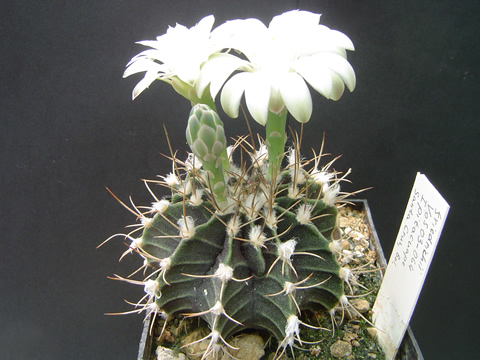
Gymnocalycium friedrichii ssp. tumaemulticostatum v květu
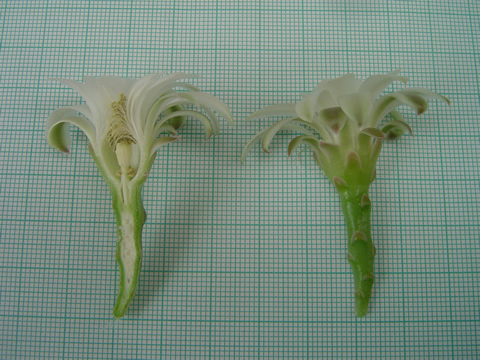
Gymnocalycium friedrichii ssp. tumaemulticostatum řez květem flower section
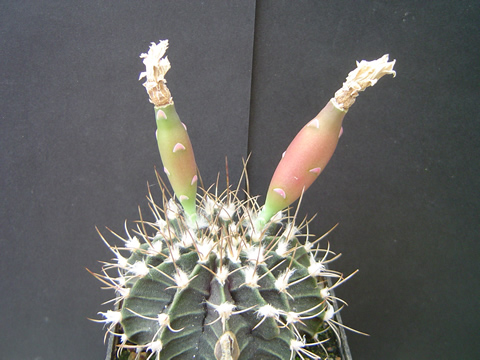
Gymnocalycium friedrichii ssp. tumaemulticostatum s nezralými plody
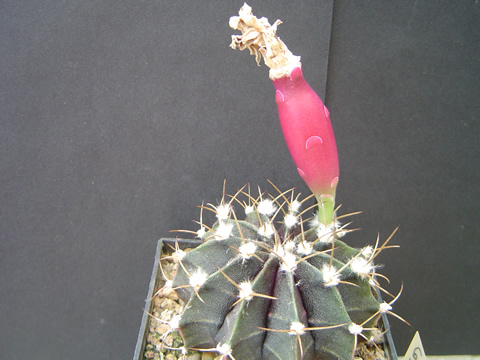
Gymnocalycium friedrichii ssp. tumaemulticostatum s dozrávajícím plodem
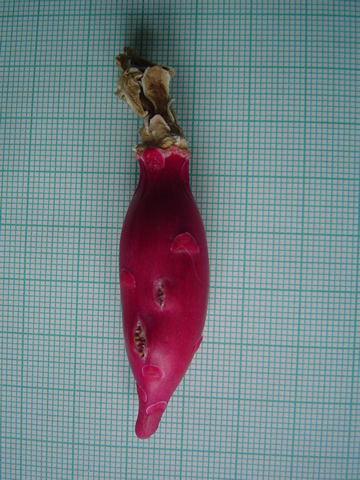
Gymnocalycium friedrichii ssp. tumaemulticostatum zralý plod
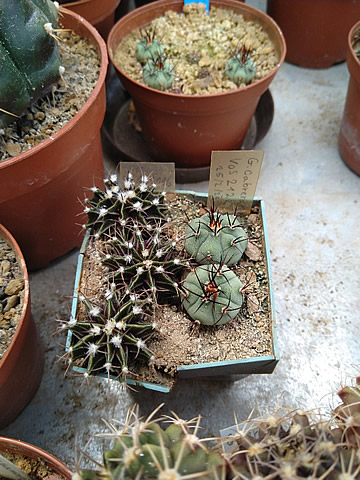
Gymnocalycium friedrichii tumaemulticostatum a Gymn cabreraense - urozená společnost Gymn. friedrichii – summary:
The taxon has been named to the merit of its discoverer Adolfo Maria Friedrich. A. M. Friedrich had been originally German, later living in Asuncion in Paraguay. The war of Paraguay amongst Bolivia was in 1933 – 1935 for the sake of the mineral riches in Chaco. The war ended by the defeating of Bolivia and the big territory has been added to Paraguay. A.M. Friedrich as the young man at that time has been working as the war writer so he had possibility to visit till that time inaccessible Chaco on new built roads. He had collected also cacti which he had grown in his garden in Asuncion, among them also Gymn. friedrichii, he has not remembered later correct place of the find. Harry Blossfeld and Oreste Marsoner visited Friedrich in Asuncion after the war, they bought all seeds and plants and then they offered them in their lists. Ing. Ryšánek from Brno has been succesful in sowing, however, after his accident he has given all plants to Zdeněk Fleischer.
The cactofil from Prague ing. František Pažout had liked very much the relationship of Gymn. mihanovichii – friedrichii, he had grown and observed many years it and then he has described several varieties, however, some of them had been the nursery products or chosen single divergences, therefore they have not been recognized. The taxa like those have been var. angustostriatum (or stenostriatum), var. melocactiforme, var ryšánekyanum and var. fleischerianum. Probably the same case is Gymn. mihanovichii var. piraretaense, later overcombined to Gymn. friedrichii var. pažoutianum, in the nature has not found, probably hybrid with Gymn. anisitsii.
On the other hand very beautiful are the taxa Gymn. friedrichii var. moserianum (syn. Gymn. stenopleurum), and Gymn. friedrichii var. albiflorum.
Gymn. friedrichii var. moserianum
It differs from the type Gymn. friedrichii with twice sized body, with only three spines in areole and with white flowers.
Homeland: After new observing Parapeti.
The other occurence reported from Teniente Enciso, Americo Picco, Cruce de 4 Mayo. Several investigators says that synonym of this taxon is Gymn. stenopleurum but we can let here the question opened for the time being.
Gymn. friedrichii ssp. tumaemulticostatum
Stem single, 7 – 10 cm in diameter, 6 – 8 cm high, when old columnar and to 10 cm high, flatly globular with deeper top, the top is immediatelly at first armed, stems seldom offspringing. Epidermis granular, dark green with strong blackviolett shadow, the stems become red in the full sun. Roots hairy. Ribs 14 – 18 in number, directly perpendicularly going, 3 – 4 mm high at the top of the stem; at the base of the stem ribs 2 (-2,5)cm wide, 1,5 – 2,5 cm high, very sharp, slightly corrugated among areoles. The striking strips on the sides of the ribs going from the areoles to the perpendicular cuts among ribs are slightly curced up. The upper margin of the strips whitish green, the down margin of the strips blackviolett to blackbrown. Perpendicular cuts slightly corrugated.
Areoles round to slightly oval, 1,5 – 2 mm wide, with white wooly feld which becomes gray soon. Marginal spines 3 – 5 (-7), needle-shaped, very outstanding, irregularly radiate spread, mostly slightly up directing, one down marginal spine to the base slightly directing, 0,7 – 1,5 cm long. Central spine 1, up directing and curved to 2,5 cm long. All spines horn gray with brown tops.
Flower 5,5 cm high, in anthese cca 4,2 cm wide, white. Tube cca 2,4 – 2,8 cm long, 2,5 mm wide at the base, cca 5 mm wide at the top, outside (smaragd-) shiny green, with cca 8 – 9 scales of wide 3,5 mm and height of 2 – 3 mm, scales with rich green base, whitish margins and brownish spot of the shade of the crescent. Ovary white, 2,1 – 2,3 cm high, 2 – 3,5 mm wide. The walls of the ovary light green in section. Receptaculum white, 2 mm wide at first, then oval to nearly round, cca 1 cm high. Outer perianths: the scales above the tube continuously coming into the perianths which are at first light green outside with white margins and whitish top under the top of the shape of a nail. Perianths 1 – 2 cm long, 4 – 5 mm wide, lanceolate. Inner perianths white, lanceolate, 1 – 2 cm long, 4 – 5 mm wide. Style 7 – 8 mm high, 1,5 mm wide, white. Stigma white, 5 – 7 mm high. Primary anthers at the base of the receptaculum short, bend to the third of the third of the style. Secundary anthers grow only at the stigma level, are light (greenish-) brown and exceeding the stigma over. Filaments white, to 0,8 cm long.
Fruit green, becomes red when mature, 5 – 7,5 cm high, 0,8 – 1,2 (-1,8) cm wide, with dry rest of the flower, narrow spindle-shaped to spindle-shaped. Seeds of the subgenus of Muscosemineum.
Homeland: Bolivia, Santa Cruz, Ipitacuqape. The taxon belongs to the affinity of Gymnocalycium friedrichii from which it differs by making many ribs, longer flowers, by much longer and narrow spindle-shaped fruit and also by quite separated natural habitation.
Holotype: The material of the holotype deposited in the Herbarium of the Regional Muzeum in Olomouc with the number B 171.826. The type culture in the collection of Ivan Milt, the original collect VoS 03-064 (Volker Schädlich).
Etymology: Taxon named in honour of Mr ing Pavel Tůma, gymnogrower from Prague, and the second part of the name means „many ribs“.
Gymnocalycium mendozaense Bercht et Schädlich
Gymnocalycium (Rakousko) 28 (3) 2015: 1171 – 1182.
Tělo jednotlivé, kulovité, až 13 cm v průměru a až 12 cm vysoké, epidermis tmavě zelená se světlejšími tahy z areol do podélných zářezů, +- malé tmavé skvrnky. Kořeny vláknité.
Žebra 8 (-13), přímá, v řezu trojhranná, proužkovaná malými světle zabarvenými příčnými zesílenými částmi, mezi areolami poněkud propadlá.
Areoly kulaté až oválné, poněkud vyčnívající z žeber, nejprve s poněkud bílou plstí, později lysé, až 6 mm dlouhé a 4 mm široké, asi 1,8 cm od sebe vzdálené.
Trny 6-9, rozprostřené a často s odstávajícími špičkami od těla, až 2,5 cm dlouhé, 0 (-1) střední trn, pokud je tak je nahoru ohnutý, trny nejprve žlutě nahnědlé, později šednoucí s tmavými špičkami.
Květy z horních částí areol blízko vrcholu, při plném otevření až 6 cm dlouhé a až 4,5 cm v průměru, zvonkovité. Perikarpel světle zelený, pokrytý šupinami stejné barvy, šupiny s bílým lemováním. Receptakulum +- 1 cm dlouhé, 1,6 cm v průměru, bílé uvnitř. Vnější lístky až 1,5 cm dlouhé a až 0,5 cm široké, narůžověle bílé se širokým nazelenale hnědým středním proužkem. Vnitřní lístky až 2,5 cm dlouhé, až 0,5 cm široké, bílé, na vnější straně s nahnědle růžovým středním páskem až k vrcholu. Vnitřní lístky zůstávají zavřené pokud nedojde k plné anthesi (tj. plné otevření za největších veder - pozn. IM). Nektarová komora 0,45 cm vysoká, 0,25 cm v průměru. Postavení primárních tyčinek na horním okraji nektaria, prašníky primárních tyčinek nedosahují laloky blizny. Sekundární tyčinky rozložené od 3 mm nad nektariem až po 12 mm květní trubky, 4-5 mm dlouhé. Nitky 0,3 mm silné, bílé. Prašníky 1,5 mm dlouhé, 0,3 mm silné, černé; pyl krémový. Blizna (bez laloků blizny) 8-10 dlouhá, 1,5 mm silná, bílá; laloky blizny 9, dlouhé 4,5 mm, krémové. Sekundární tyčinky ohnuté dovnitř, zakončené až 9 mm nad bliznou.
Plod vřetenovitý, +- 3 cm dlouhý, tmavě červený, zůstávající zbytky květu +- 1,5 cm dlouhé. Několik šupin až 3 mm dlouhých, 1,5 cm širokých, stejné barvy jako plod, okraje šupin růžově červené. Plod se otevírá svislou puklinou. Plodové maso červené.
Semeno +- kulaté, nažloutle až světle hnědé. Buňky testy vypouklé, často vtisknuté na vrcholu. Hilum přímé, 0,5 mm dlouhé, 0,2 mm široké, velmi mírně vnořené, s trochou bíle nažloutlým tkanivem.
Domovina: na stráních Cerro Cabrera, roste společně s Gymnocalycium pflanzii. Doprovodná flora Cereus spec. a Bromelia spec.
Etymologie: Jde o starší výraz „mendozaense“. Jméno odkazuje na vojenskou základnu Fortin Teniente Gabino Mendoza, provincie Boqueron, Paraguay.
Starší gymnofilové již mají rostliny ve sbírkách z dob sběrů Horsta a Uebelmanna, pro kteroužto firmu sbíral i holandský profesor A.F.H. Buining pod číslem HU 312. Nové nálezy pocházejí z provenience sběratelů Ludwiga Berchta a Volkera Schädlicha, s číslem např. VoS 606 z malého pohoří Cerro Cabrera, které ani příliš nepřipomíná nějaké pohoří, jako spíš nějakou stolovou horu třebas u Cape Town.
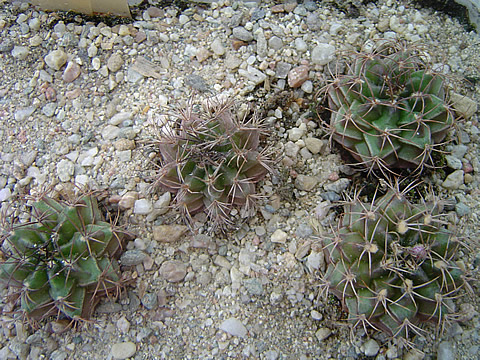
Gymnocalycium mendozaense VoS 606 Cerro Cabrera |